


Sign letters are chosen twice: first the construction, then the font — and the second choice is limited by the first. A flat-cut letter is a solid plate, so almost any font that keeps a 5 mm stroke can be cut. A box-up letter is a strip of steel folded round the letter's outline, and in our workshop that strip will not fold tighter than a 10 mm inside radius — so a script S whose ends curl at 2 mm cannot be made as a box-up, however much you want it lit. This guide walks through the four constructions, which suits which shop, and then measures our six lettering faces against the rules, so you can pick a type and a font that can actually be built, and know what we check before anything goes to the bench.
The four kinds of sign letter

Every dimensional letter we make is one of four constructions:
| Type | How it is built | Lights up? | Typical use | Watch out for |
|---|---|---|---|---|
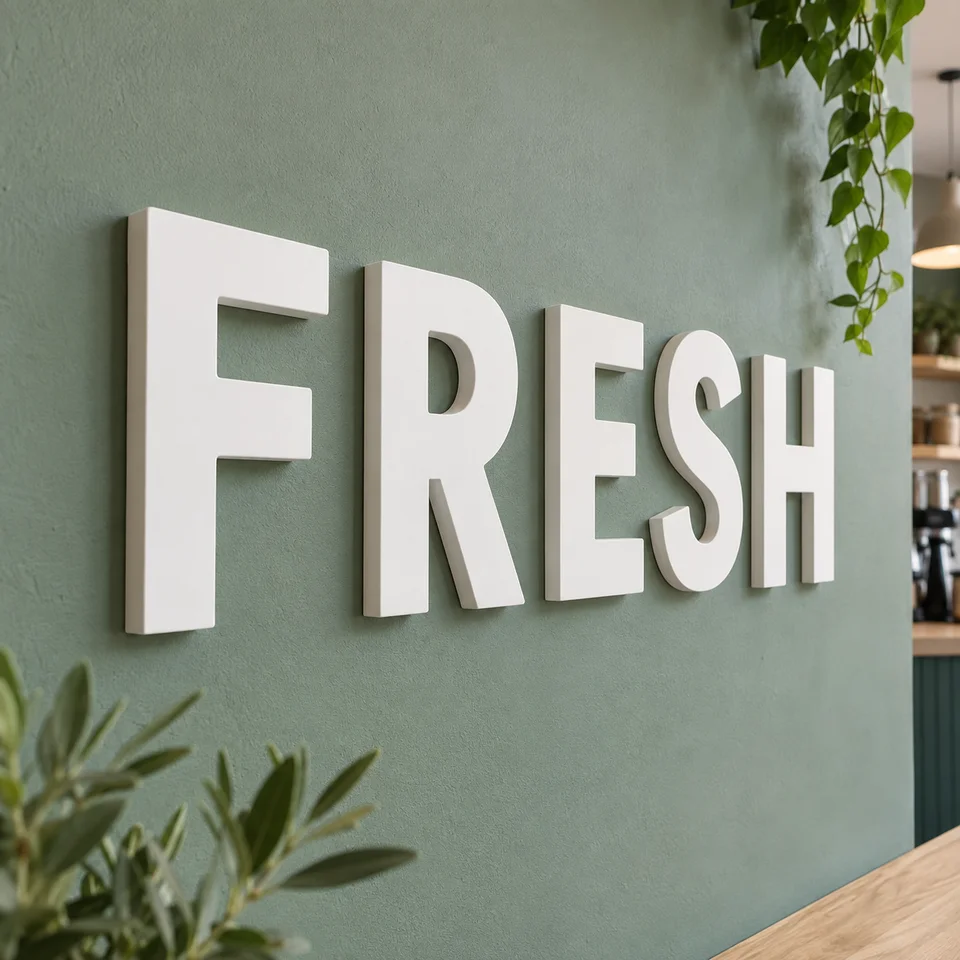
| Flat-cut | Laser- or CNC-cut from a solid sheet: PVC foam, acrylic, wood, stainless steel or EG steel | No — a backing tray can carry LED behind it | Receptions, office walls, boutiques, building names | Thin strokes snap, and thin steel flexes and dents ("oil-canning"); letters under 30 mm (50 mm in metal) are not cut |
| Box-up, front-lit | A metal strip folded round the outline and welded, with a 3 mm acrylic face that glows | Yes, from inside | Shopfront fascias, mall units, anything read after dark | Curves under 10 mm, strokes too narrow for the module, letters under 80 mm |
| Box-up, halo | The same box with a solid face and an open back; light spills onto the wall behind | Yes, as a halo | Hotel lobbies, clinics, premium fascias on a pale wall | Needs a flat, light-coloured wall close behind it to show the halo |
| 3D-printed | Printed layer by layer in PLA or PETG, printed in colour or primed and sprayed | Yes, as a hollow print with an acrylic face | Script logos, fine serifs, small runs, custom depths | Layer lines on a raw print; PLA is indoor-only |
Which one you need is mostly settled by three questions: does it have to light up, is it outdoors, and what does the font look like. The sections below take them in turn. All eleven letter ranges sit under one page, Sign Letters, and each one quotes live as you type a word and a height.
Flat-cut letters: the everyday choice

A flat-cut letter is the letterform cut straight out of a sheet, so the material list is the price list:
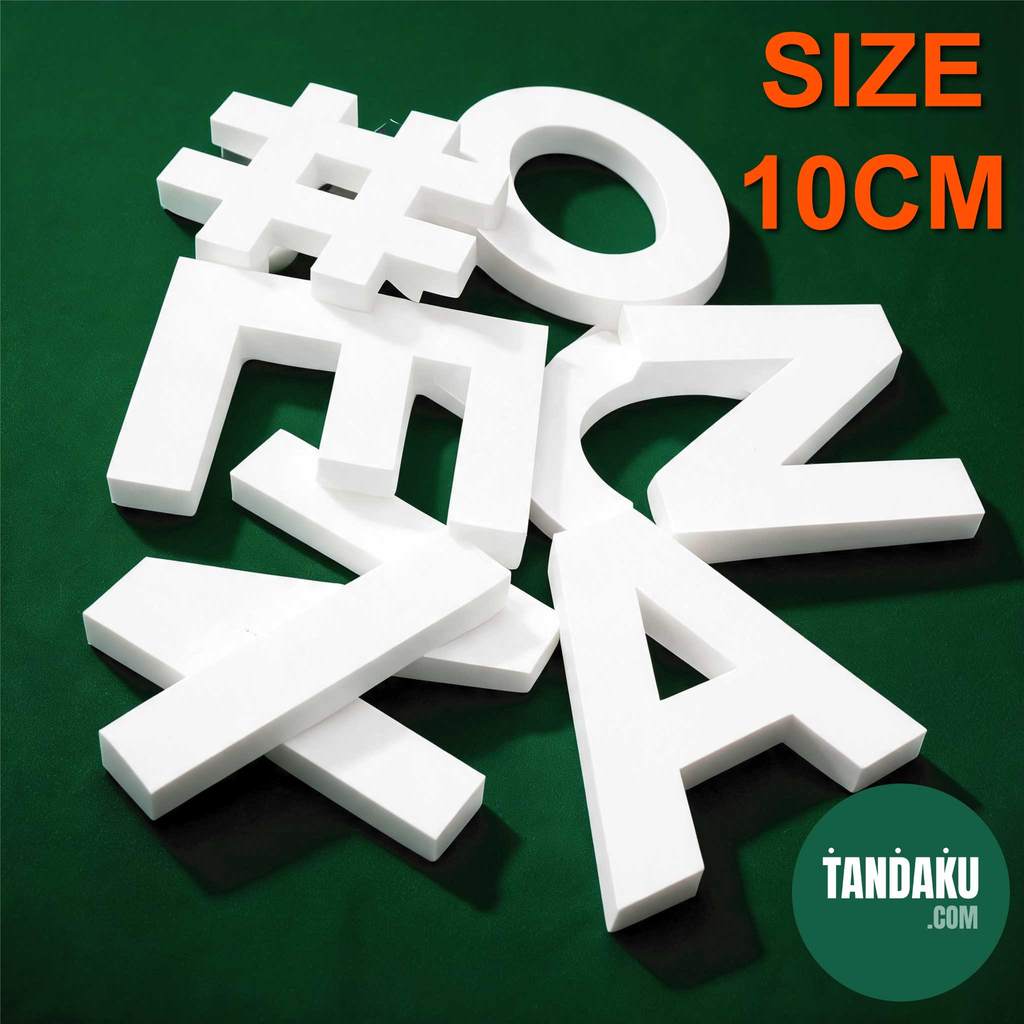
- PVC foam, 5 to 25 mm — the cheapest dimensional letter, waterproof, and light enough for double-sided tape. The 5 and 10 mm sheets also come in through-coloured black, which saves a paint job. See PVC letters.
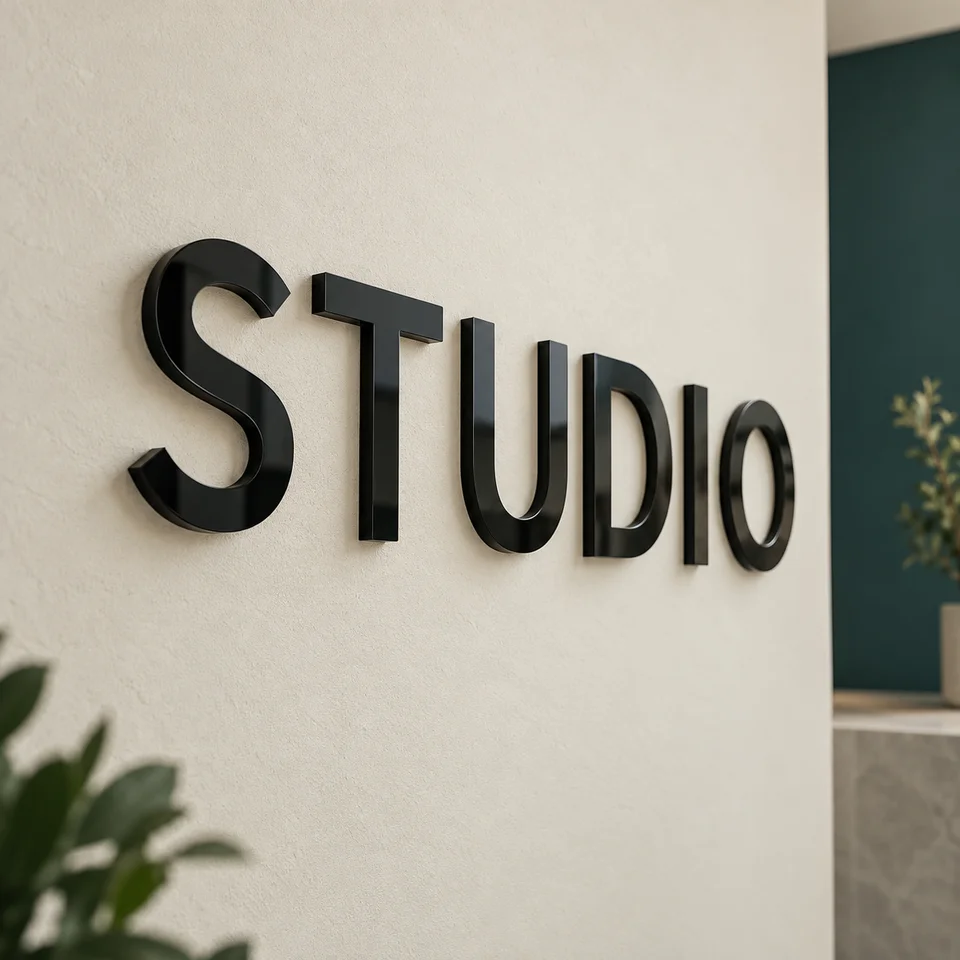
- Acrylic, 2 to 10 mm — the house standard indoors: clear with flame-polished edges, black or white in matte and gloss, stock colours and tints coloured right through the sheet, frosted, wood-look, glow-in-the-dark, and 2 mm mirror gold, silver and rose gold. Mirror acrylic marks easily, so it stays indoors or under shelter. See acrylic letters.
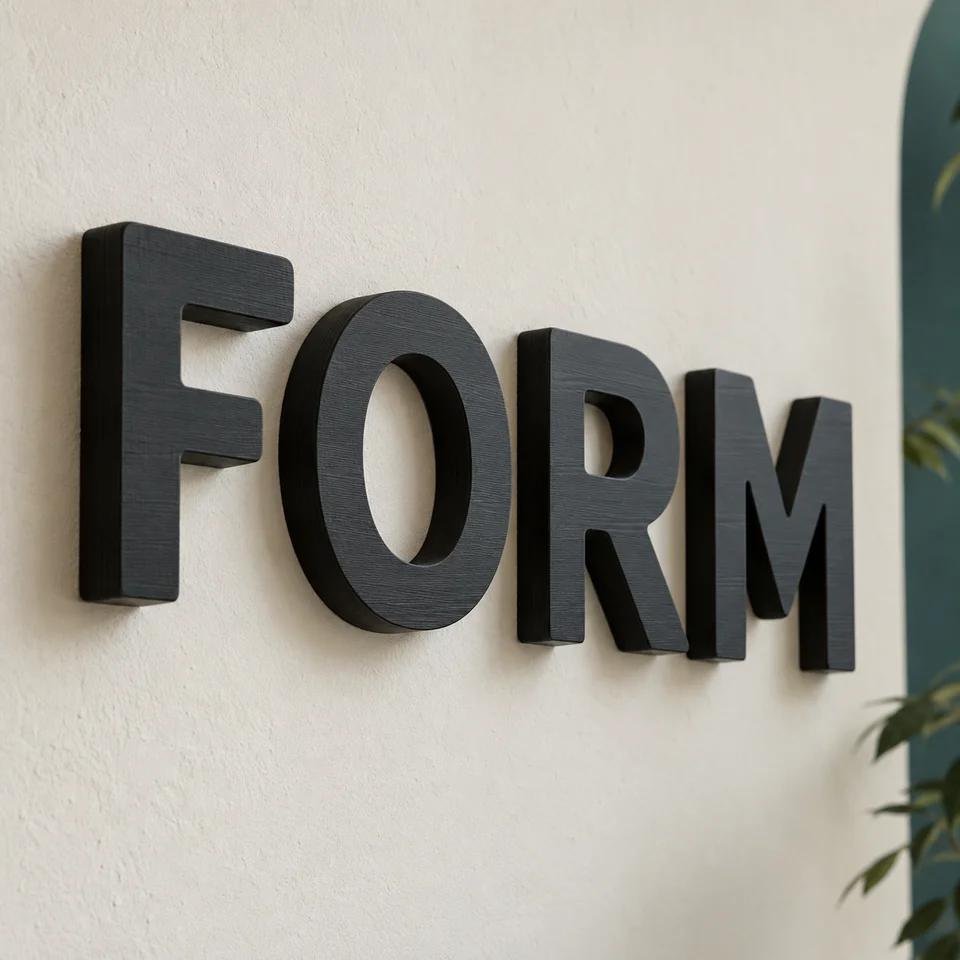
- Wood — 3 and 5 mm plywood, 5 and 12 mm MDF for a flawless painted face, 9 mm OSB and 12 mm solid rubber wood. Indoors. See wood letters.
- Metal — 1 mm 304 stainless in hairline, mirror, gold PVD or black PVD; a 1.5 mm plate in black PVD for letters over 500 mm (and in sprayed gold or silver for indoor budget jobs); and 0.5 or 1.5 mm electro-galvanised (EG) Colourbond steel for an outdoor fascia letter at a shopfront price. See metal letters.
Pros: the widest choice of colours and finishes, the lowest prices, seven working days (Express, 3 working days, on acrylic, PVC and wood letters only; flat-cut metal has none), and almost any font. The one limit is that the narrowest stroke should stay at or above 5 mm at the height you order, because thinner acrylic snaps and thinner steel oil-cans; the configurator warns you when a face falls under it. Letters go up on stand-off studs, tape or a backing panel — see how to mount an acrylic sign.
Cons: no depth beyond the sheet thickness, so a 3 mm letter throws barely any shadow, and no light from inside. A lit flat letter is a flat letter with LED on a tray behind it: a halo effect, never a glowing face.
Box-up letters: hollow, lit, and folded from a strip

Box-up letters (channel letters, to a signmaker) are what most people picture when they say 3D signage: a hollow letter with sides, a face and, usually, LED modules inside. The sides — the return — are a strip of sheet metal folded round the outline of the letter and welded wherever two ends meet. That one fact decides almost every rule later in this guide.

We build box-up letters in three metals:
| EG steel | Aluminium | Stainless steel | |
|---|---|---|---|
| The box | Electro-galvanised steel, folded and welded; the body can be 2K spray-painted | Sheet aluminium formed into the return | 304 stainless, welded and hand-polished at every seam |
| Finish | Raw galvanised body included; 2K painted to any Pantone or RAL as an add-on | The return is left as formed; the colour comes from the acrylic face (front-lit) or the painted solid face (halo) | Brushed hairline or gold PVD — the colour is the metal, so nothing flakes |
| Weight | Heaviest | Lightest, which matters three floors up | Heavy |
| Outdoors | Yes once the body is painted — the paint is the weatherproofing | Yes, it does not rust | Yes, in coastal and city air alike |
| Minimum charge per line | RM220 | RM250 | RM750 |
| Best for | The value lit letter under a canopy or on a dark fascia, or when the body must match a brand colour | The everyday fascia letter, exposed or sheltered | Corporate HQs, hotels, banks and jewellers |
All three come with a 1-inch (25 mm), 2-inch (50 mm) or 3-inch (75 mm) return. One inch is the light, cheap default for indoor walls and unlit letters. Two inches is the shopfront standard, because the LED modules need that cavity to light the face evenly with no hot spots. Three inches is for letters 250 mm and taller only — a 75 mm strip cannot be folded onto anything much smaller. The front face is stocked 3 mm acrylic in white, red, green, yellow, pink, grey, deep grey, frosted or a tinted colour, or UV-printed to any colour you send.
Pros: real depth and a shadow line by day, a glowing face by night, and a metal that lasts. Cons: the price, a seven-working-day lead time with no express (folding, welding, filling and curing cannot be rushed), a minimum letter height of 80 mm, and a font limit that flat-cut letters do not have — the 10 mm bend rule below.
Front-lit or halo-lit?

A front-lit letter has the acrylic face: the letter itself glows and reads clearly from across the road. A halo (backlit) letter has a solid metal face, painted matte black in nine jobs out of ten, and an open back, so the light spills onto the wall behind and the letter reads as a crisp silhouette inside a ring of glow.
Front-lit is the choice for a street fascia and anything that has to be read from a distance at night. Halo is the quieter, more expensive-looking effect, the one hotels, private clinics and luxury retail ask for; its one condition is a flat, pale wall close behind the letters, because the halo is light on that wall, which is why it suits a lobby feature wall better than a busy fascia over a shop window. We make halo letters in aluminium, stainless steel and EG steel. Both kinds run on 12 V DC through an LED driver, with IP68 potted modules for anything that sees rain.
3D-printed letters: for the fonts metal cannot hold

A 3D-printed letter is built up layer by layer in PLA or PETG, so it holds shapes a cutter or a folder cannot: fine script joins, hairline serifs, ball terminals, domed or chamfered faces, logo marks and any depth you ask for. It is the answer when the brand font is a flowing script and the client still wants real depth, and it can be printed hollow with an acrylic face and LED, so it can light too.
Pros: any font from 30 mm tall, colour right through the material, no paint to chip on a black or white print.
Cons: layer lines show on an unpainted letter up close (grey hides them best), PLA belongs indoors (PETG for hot, sheltered outdoor spots), and it is seven working days with no express.
Which letter type for which situation

| Where the sign lives | First choice | Why | Also consider |
|---|---|---|---|
| Exposed shopfront fascia that must read at night | Aluminium box-up, front-lit, 50 mm return | Rust-proof without paint, light to hang, and at RM614.77 for a lit 300 mm seven-letter word it undercuts a painted EG box (RM727.91) | EG steel box-up at RM576.93 lit with the raw galvanised body where the fascia is sheltered or dark, or painted when the body must be a brand colour |
| Mall unit under bright mall lighting | Aluminium box-up, front-lit | Light, rust-proof and the everyday fascia choice; a coloured acrylic face carries the brand colour | Stainless box-up for a premium unit |
| Office or clinic reception | 3 or 5 mm acrylic flat-cut on studs | Best value indoors, clean, any colour; black matte stays readable under downlights | Halo aluminium if there is a pale feature wall to light |
| Hotel lobby, bank branch, corporate HQ | Stainless steel box-up, hairline or gold PVD, halo or front-lit | Built to hold its finish for a decade, because the finish is in the steel, not on it | 1 mm hairline stainless flat-cut on studs for a quieter wall |
| Café or boutique with a script logo | 3D-printed, or flat-cut acrylic (joined script from 250 mm tall, handwriting from 50 mm) | The only constructions that hold a script's joins and tapers | Mirror acrylic flat-cut indoors for a salon or bridal look |
| Building name high on a facade | 1.5 mm black PVD stainless flat-cut, or stainless box-up | Rigidity over 500 mm and a finish that holds in weather | Aluminium box-up where weight matters |
| Temporary, event or budget interior | 5 or 10 mm PVC foam flat-cut | Waterproof, light enough for tape, the lowest price | 5 mm MDF for a painted face |
Indoor or outdoor: what the weather does to each material

Malaysian weather is the test every sign letter eventually sits: afternoon sun, then an hour of rain, most days of the year.
- 304 stainless steel shrugs it off, hairline or mirror, and gold or black PVD is bonded into the steel rather than painted on. Sprayed stainless, the gold and silver options on the 1.5 mm plate, is paint and belongs indoors or under shelter.
- EG steel is galvanised, and the optional 2K paint is what keeps it weatherproof for the long run. The raw galvanised body is fine where the sides are barely seen or sheltered, such as a letter tight against a dark fascia under a canopy. A chipped, unpainted edge is where a rust streak starts.
- Aluminium does not rust, which is why it is the everyday fascia metal, and it is the lightest box to hang.
- Acrylic coloured through the sheet does not peel or fade the way a vinyl wrap does; mirror acrylic marks and should stay indoors or sheltered.
- PVC foam is closed-cell and will not swell in the monsoon. Wood stays indoors. 3D prints are PETG for hot, sheltered spots and PLA indoors. Glow acrylic needs daylight to charge — a letter in a permanently dark corner will not glow.
For the wider material story see how to make outdoor signage last in Malaysian weather.
Which fonts suit which letter type

The configurator on every letter page offers six faces, and because they are real fonts we can measure them rather than guess. Two rules do the sorting:
- Flat-cut: the narrowest stroke should be at least 5 mm at the height you order. Below that, acrylic snaps and thin steel oil-cans. The configurator warns when a face falls under it.
- Box-up: no curve on the outline tighter than a 10 mm inside radius, because the strip will not fold tighter, plus enough stroke for two return walls and, if lit, a module between them.
What that means face by face, at the cap height you type:
| Face | Style | Flat-cut from | Box-up | 3D-printed |
|---|---|---|---|---|
| Oswald Bold | Condensed sans — the everyday shopfront letter | 60 mm | Capitals from 290 mm; lowercase from 430 mm (the g curls at 7 mm at 300 mm) | Any height |
| Archivo Black | Heavy, wide block sans | 40 mm (50 mm in metal) | Capitals from 250 mm; the lowercase r ends in a curl under 0.5 mm, so capitals only | Any height |
| JetBrains Mono Bold | Even-width technical letters | 60 mm | Everything from 210 mm | Any height |
| Caveat Bold | Relaxed handwriting | 50 mm | No — the wobble of handwriting is curves under 1 mm | Any height |
| Playfair Display Bold | Formal serif with hairlines | 190 mm | Only from 760 mm; the ball terminals and serif brackets are 4 to 6 mm at 300 mm | Any height |
| Great Vibes | Flowing joined script | 250 mm | No — 2 mm curls, and joined letters would become one thin box | Any height |
The short version: bold sans-serif capitals are the safe box-up choice; script, handwriting and fine serifs go flat-cut at a generous height, or 3D-printed at any height. If you are sending your own font or a logo, the same two rules apply and we check them on your actual artwork. A bold geometric sans with square-cut ends will almost always pass; a serif with bracketed feet or a script with tapered tails almost always will not at shopfront sizes.
The 10 mm bend rule for box-up letters

Here is the rule that started this guide. In our workshop the return is folded round every curve of the letter, and the tightest inside radius it will take is 10 mm. Tighter than that and the strip kinks, the weld cannot be dressed and the face will not sit flat.
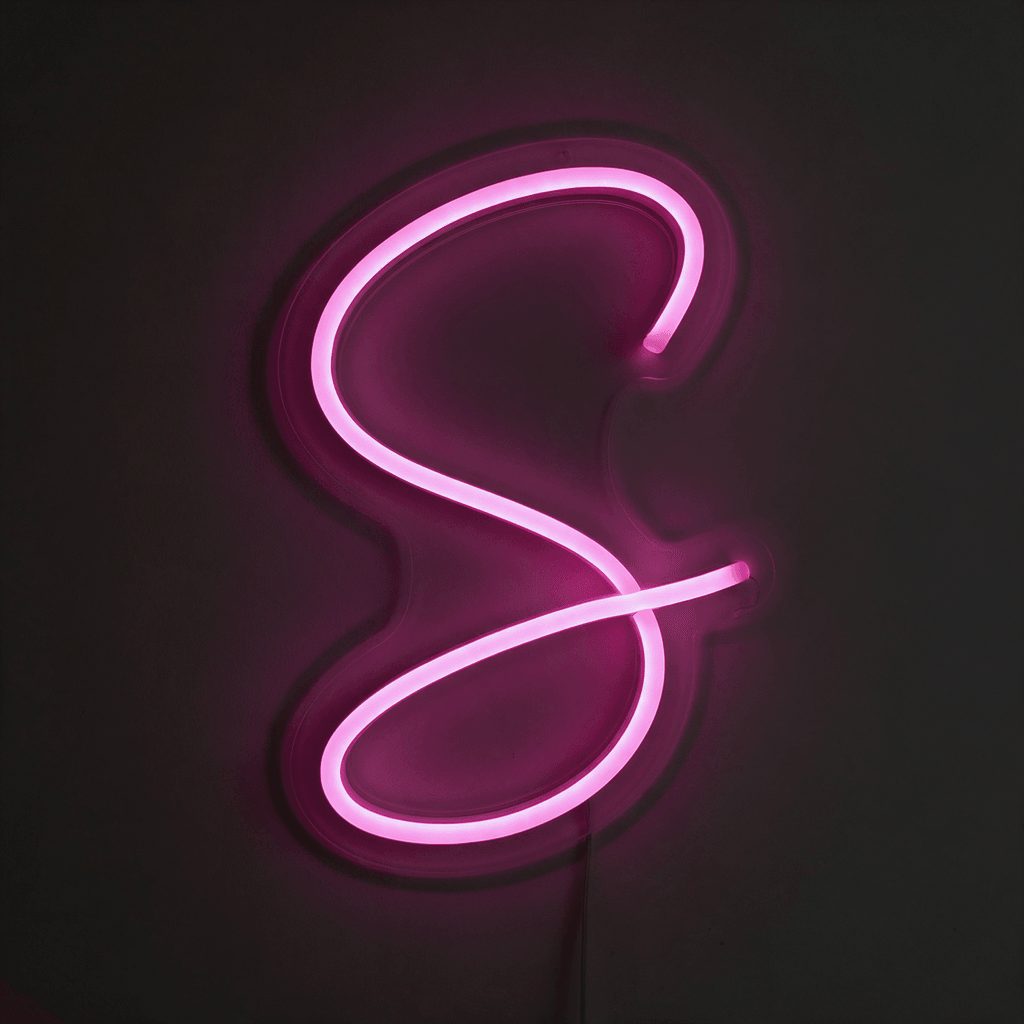
The picture above puts two letters S side by side at the same 300 mm cap height. On the Great Vibes S the stroke tapers into a curl at each end, and the radius of that curl is about 2 mm — five times tighter than the strip can go. It does not matter that the rest of the letter is fine: the two ends cannot be built, and shortening the tails turns the letter into something else. On the Oswald Bold S the tightest curve is the inside of each bowl at about 10 mm, so it clears, just. Make the same letter 250 mm tall and that curve becomes 9 mm, which is why height and face have to be judged together, not one after the other.
Two things follow. First, a corner is not a bend: where the outline turns sharply, two ends of strip meet and are welded, then ground smooth, so square-cut terminals and sharp apexes are fine. Second, a curve only counts as a bend if it is one. A tiny rounding on a corner is simply welded as a corner, but a hook that reverses direction inside a continuous stroke is a bend the strip is already in, and it cannot be welded away. What cannot be helped is a curl, a hook, a ball terminal or a tapered tail, because those are the letter.
Ends, holes and gaps

The same 10 mm bend shows up in three more places:
- Rounded ends. A round terminal is a half circle whose radius is half the stroke width, so a rounded stroke has to be at least 20 mm wide to be folded. A square-cut end is welded instead, so a squarer face can run a narrower stroke — and a lit letter needs enough width for the LED module to sit between the two walls in any case.
- Counters. The hole in an e, a, B, 8 or 0 is boxed too: the strip is folded the other way and welded from inside. The tightest curve inside the hole must also be 10 mm or more, and the hole has to be wide enough to get a tool and a weld into. Small counters on small letters would have to be filled in, which is rarely what the brand wants, so we flag them on the proof rather than fill them.
- Gaps. Each letter is its own welded box on its own studs, so letters must not touch. Joined script would have to become one long, thin box — another reason script goes flat-cut or 3D-printed.
Our six faces measured at 300 mm

We measured the outline curvature of every letter in the six faces at a 300 mm cap height, counting only genuine bends (a run of curve turning 60° or more over at least 6 mm of outline), because corners are welded, not bent.
| Face | Tightest curve on the S | Tightest across A–Z | Tightest across a–z | Body stroke | Box-up verdict at 300 mm |
|---|---|---|---|---|---|
| Oswald Bold | 10 mm | 10 mm (S) | 7 mm (g) | 26 mm | Capitals yes; lowercase from 430 mm |
| Archivo Black | 12 mm | 12 mm (S) | under 0.5 mm (r) | 38 mm | Capitals yes, from 250 mm; no lowercase |
| JetBrains Mono Bold | 29 mm | 29 mm (S) | 14 mm (m) | 29 mm | Yes, everything, from 210 mm |
| Caveat Bold | 0.3 mm | under 0.5 mm (E) | under 0.5 mm (p) | 31 mm | No |
| Playfair Display Bold | 6 mm | 4 mm (X) | 5 mm (s) | 8 mm | Only from 760 mm |
| Great Vibes | 2 mm | 0.6 mm (H) | 0.5 mm (u) | 6 mm | No |
A figure under a millimetre is not a corner that slipped through the filter: it is a hook or wobble inside a continuous stroke, a bend that turns through 60° or more and cannot be welded as a corner. Because curves scale with the letter, a face that fails at 300 mm can pass when it is bigger: Playfair's serifs reach 10 mm at a 760 mm cap height, which is building-name size, not shopfront size. The handwriting and script faces never get there; their tightest curves are fractions of a millimetre and would need letters several metres tall.
Size, depth and lighting limits
The fixed numbers, straight from what the configurator will accept:
- Letter height: flat-cut PVC, acrylic, wood and 3D-printed letters from 30 mm; flat-cut metal from 50 mm; box-up from 80 mm; everything up to 1,500 mm tall, in a line up to 6 m wide. The 80 mm is what the configurator accepts for a box-up; with our six faces the 10 mm bend rule sets the practical floor at about 210 mm (JetBrains Mono Bold, everything), 250 mm (Archivo Black capitals) or 290 mm (Oswald Bold capitals). The configurator does not check bends; the proof does.
- Return depth: 25, 50 or 75 mm; 75 mm only on letters 250 mm and taller; pick 50 mm for a front-lit letter.
- Lighting: indoor modules, or IP68 potted outdoor modules for anything exposed. Every lit letter runs on 12 V DC through a 100 W or 300 W driver (indoor or rainproof); wiring modules straight to the mains destroys them and is not covered by warranty.
- Faces and colours: stocked 3 mm acrylic colours or UV print on front-lit letters; matte black, matte white or any sprayed colour on halo faces; any Pantone or RAL on an EG body.
- Turnaround: seven working days from proof approval for every letter range. Express, 3 working days, is available on acrylic, PVC and wood letters only; metal, box-up, backlit and 3D-printed letters have no Express.
- Delivery: small runs go by courier; a long run of large letters is a Lalamove or self-pickup job, and the checkout tells you which.
Before you order: what we check

When a box-up order comes in we do not start folding; we check the artwork against the list below and send a proof. Nothing is fabricated until you approve it, so a problem is settled before any material is cut. Send these with the order and the proof comes back faster:
- Vector artwork — AI, PDF or SVG with text converted to outlines; we cannot fabricate from a JPG or PNG.
- Letter height — 80 mm is the configurator's floor for a box-up; with our faces the bend rule puts capitals at 210 to 290 mm, and lit letters read best from about 200 mm.
- Tightest bend — 10 mm or more on every curve of every letter, holes included.
- Stroke width — 20 mm where the ends are rounded; room for the module if it is lit.
- Counters and gaps — holes we can weld inside, letters that do not touch, no joined script.
- Return depth against height — 75 mm only on letters 250 mm and taller.
- Lighting — front-lit or halo, indoor or outdoor modules, and the driver that goes with them.
- Colours in writing — the face colour, and a Pantone or RAL for any sprayed steel.
- Mounting and site — stud fixings with a paper template are standard; tell us the wall or fascia material. A shopfront sign also needs its council licence.
- Proof approval — fabrication starts when you approve the drawing, and the seven working days count from there.
What each letter type costs
Every price below is the live quote for the same word — SIGNAGE, seven letters, 300 mm tall in Oswald Bold, a line 1,287 mm long — taken from our price engine on 12 September 2026. Your word will differ: open Sign Letters, pick a range, type the word and the height, and the quote updates as you type.
| Construction | Material and options | Price |
|---|---|---|
| Flat-cut | 10 mm white PVC foam | RM104.25 |
| Flat-cut | 3 mm black matte acrylic | RM131.27 |
| Flat-cut | 12 mm MDF | RM151.87 |
| Flat-cut | 2 mm gold mirror acrylic | RM154.44 |
| Flat-cut | 5 mm black matte acrylic | RM164.74 |
| 3D-printed | Black PLA / PETG | RM241.96 |
| Flat-cut | 0.5 mm EG Colourbond steel | RM262.55 |
| Box-up, unlit | EG steel, 25 mm return | RM265.12 |
| Box-up, unlit | Aluminium, 25 mm return | RM296.65 |
| Flat-cut | 1.5 mm EG Colourbond steel | RM337.19 |
| Halo, lit | EG steel, 25 mm return, outdoor LED and driver | RM504.61 |
| Box-up, lit | EG steel, 50 mm return, outdoor IP68 LED and driver | RM576.93 |
| Box-up, lit | Aluminium, 50 mm return, outdoor IP68 LED and driver | RM614.77 |
| Box-up, lit | EG steel as above, with the body 2K painted | RM727.91 |
| Flat-cut | 1 mm hairline or gold PVD stainless | RM785.07 |
| Box-up, unlit | Hairline stainless, 25 mm return | RM1,312.74 |
| Halo, lit | Hairline stainless, 25 mm return, indoor LED and driver | RM1,368.48 |
| Halo, lit | Hairline stainless, 25 mm return, outdoor LED and driver | RM1,471.14 |
Two patterns are worth noticing. The metal is the price, not the light: moving from an unlit 25 mm EG or aluminium box to a lit 50 mm one adds about RM310 to RM320 on this word. And a lit EG box-up (RM576.93) still costs less than an unlit stainless flat-cut (RM785.07). For a shorter guide to choosing and pricing letters for a shop sign, see the 3D signboard guide.
FAQ
What is a box-up letter?
A hollow metal letter: a strip of aluminium, stainless steel or EG steel folded round the letter outline and welded, with a face on the front. Front-lit box-ups have a 3 mm acrylic face that glows from LED modules inside; halo box-ups have a solid face and light the wall behind them. Signmakers also call them channel letters.
Which is better for a shopfront: EG steel, aluminium or stainless steel box-up letters?
For an exposed shopfront, aluminium: it does not rust without paint, it is light, and at RM614.77 for a lit 300 mm seven-letter word it costs less than an EG box with its body painted for the weather (RM727.91). EG steel is the value pick when the fascia is sheltered or dark and the raw galvanised body can stay as it is (RM265.12 unlit, RM576.93 lit), or when the body must match an exact Pantone or RAL. Stainless steel is for signs that have to look expensive for a decade — hotels, banks, jewellers — at roughly three to five times the EG price, depending on lighting and paint.
Can a script or handwriting font be made as box-up letters?
Not in our workshop. The return strip will not fold tighter than a 10 mm inside radius, and script and handwriting faces curl to 2 mm and less at shopfront sizes; joined script strokes would also have to become one long, thin box. Make the letter flat-cut in acrylic or metal instead (handwriting faces such as Caveat Bold from about 50 mm tall, joined script such as Great Vibes from about 250 mm), or 3D-print it at any height — a hollow print can carry an acrylic face and LED.
What is the minimum size for box-up letters?
80 mm cap height with a 25 mm return is the smallest the configurator accepts. In practice the 10 mm bend rule sets the floor: about 210 mm in JetBrains Mono Bold, 250 mm for Archivo Black capitals and 290 mm for Oswald Bold capitals; below that, go flat-cut or 3D-printed. The configurator does not check bends, so we check them on the proof before anything is made. Lit letters read best from about 200 mm, and the 75 mm return is only offered on letters 250 mm and taller. Flat-cut letters start at 30 mm (50 mm in metal) and 3D-printed letters at 30 mm.
Why can't the ends of my S be made?
Because they curl. On a script or serif S the stroke tapers into a hook or a ball at each end, and the outline there turns with a radius of a few millimetres. The steel return has to follow that outline and cannot bend tighter than 10 mm, so the two ends cannot be built even though the rest of the letter can. A bold sans-serif S with square-cut ends has no curl to follow.
Do box-up letters have to be lit?
No. An unlit box-up is the same welded box with no module fitted: you get the depth, the shadow line and the metal without wiring, a driver or an electricity bill, and it is the cheapest box-up.
How long do fabricated letters take?
Seven working days from the day you approve the proof, for flat-cut, box-up and 3D-printed alike. Express, 3 working days, is available on acrylic, PVC and wood letters only. Aluminium, stainless steel and EG steel box-up and backlit letters, flat-cut metal letters and 3D-printed letters have no Express, because they are harder to make.
Can I use my own font or logo?
Yes. Upload vector artwork (AI, PDF or SVG with text converted to outlines) and we check it against the same rules — 5 mm strokes for flat-cut, 10 mm bends and workable counters for box-up — on your actual letterforms before anything is fabricated. If a shape cannot be built in the type you chose, we will say which letters and why, and suggest the height or construction that solves it.
Price your letters
All eleven ranges live on one page: Sign Letters. Pick flat-cut PVC, acrylic, wood or metal, an aluminium, stainless or EG box-up, a halo letter or a 3D print, then type your word and height, choose the return and lighting, and the total shown is the price you pay. Upload the artwork with the order and the proof follows. Related reading: 3D signboards: types and prices · how to mount an acrylic sign · signboard licence guide